You can’t help but listen when this chocolate maker starts talking chocolate. He talked a group of us eager tasters through the flavors of his various beans/bars at the NWCF, and it was plain to see his enthusiasm. Let me introduce you to Foundry Chocolate, launched by David Herrick and his wife, Janelle Herrick, in 2018 in Auckland, New Zealand. Foundry is considered a micro-batch bean-to-bar craft chocolate company. Microbatch chocolate makers typically produce small quantities ranging from 5 to 100 pounds (2–45 kg) per batch, emphasizing hands-on craftsmanship, and for Foundry, to highlight the unique flavor profiles of each cacao origin. To further this, Foundry only uses 2 ingredients–cacao beans and organic sugar. Foundry Chocolate has won >34 awards from the Outstanding Food Producer Awards, Academy of Chocolate Awards London, NZ Chocolate Awards, and others.
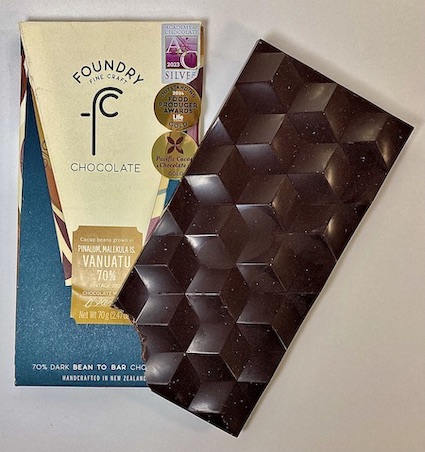
Now let me introduce you to Foundry’s 70% Vanuatu chocolate bar. This single origin bar is made with cacao grown on the very remote island of Malekula, the second-largest island in the nation of Vanuatu. The cacao is grown by a small group of farmers from Pinalum Village.
Sight: outer packaging is attractive; dark brown in color; clean molding in classic pattern; good shine; my photography skills are declining however–the picture shows crud on the bar–that’s only in the picture and not in real life, but I’d already eaten most of the bar by the time I started this post…so a make-up picture wasn’t an option
Sound: good snap with break
Smell: mild intensity; dried fruit
Mouth Feel: creamy, even melt
Taste: initially has a deep chocolate flavor that welcomes secondary notes of dark caramel, then finishes with toast
Astringency: mild
Summary: Like the last Vanuatu origin bar I reviewed, there are no fruit flavors here. That’s not my preference in chocolate, but I love this bar. Its oh-so-rich chocolate flavor is complimented well by the notes of dark caramel and toast. This is a chocolate bar I plan to buy again and again, if I can find it as distribution in the US is frustratingly limited.